
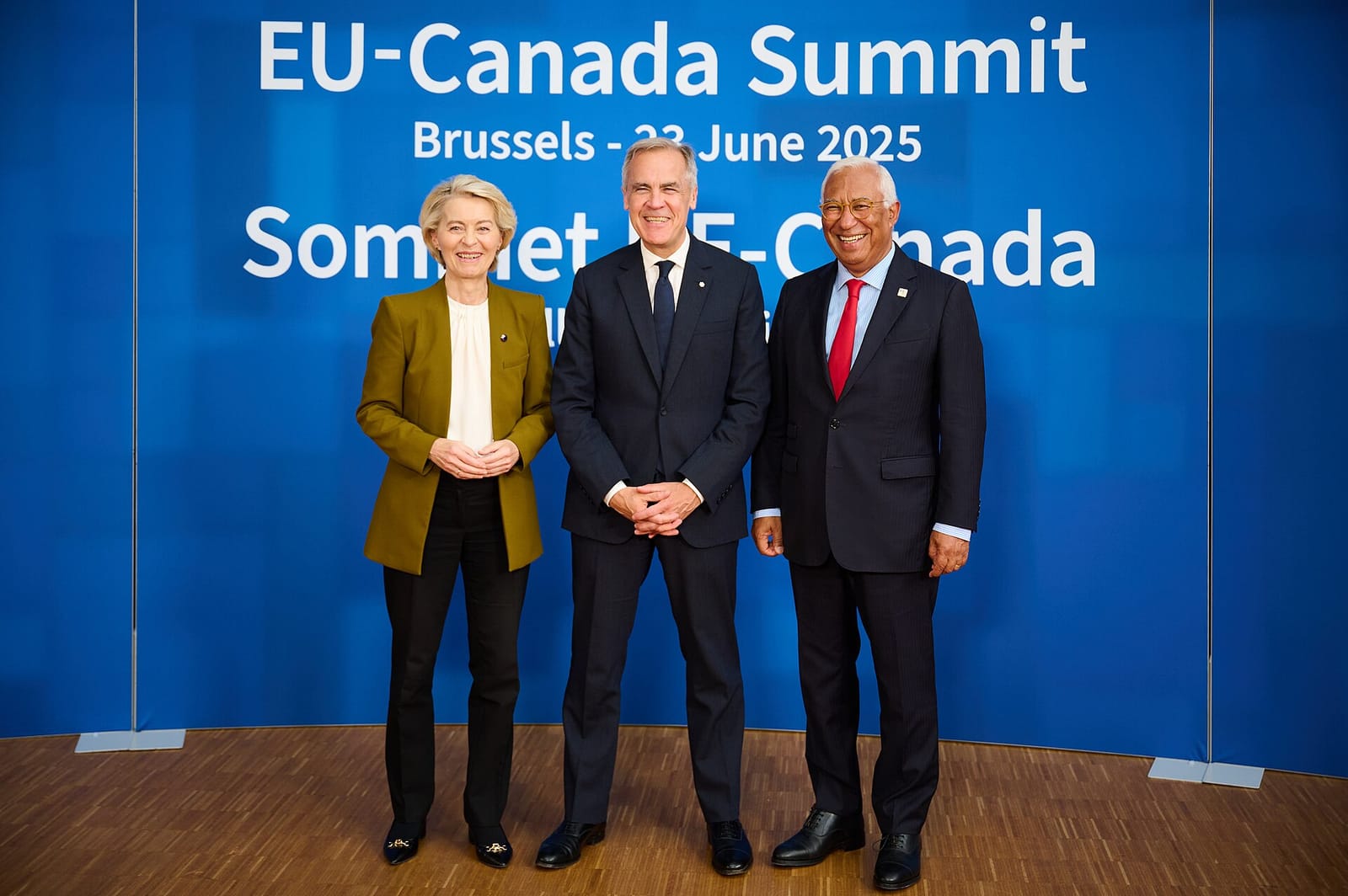
The European Union has dropped the words “associate membership” from the declaration it plans to adopt with Canada this week. The latest draft speaks instead of an “ever closer association”, short of full membership, Euronews reported on Wednesday. The text is due to be adopted at the EU-Canada summit in Montréal on 29 and 30 October, which Prime Minister Mark Carney hosts with European Council President António Costa and Commission President Ursula von der Leyen.
The label itself was never a legal category. For technology, the most concrete links between Canada and the EU sit in separate arrangements: some are binding agreements already in force, others are commitments to cooperate. Whether the newest technology items survive the change of wording is not yet known.
Why the label went
Von der Leyen made the offer in her State of the Union speech in Strasbourg on 16 September, with Carney in the chamber as her guest. “I would like to work with you on opening the door for Canada to be the first associate member of the EU,” she told him. The EU treaties do not provide for such a status.
That was the problem for several capitals. Germany was the most vocal opponent, and France, Italy and Greece also raised issues with the earlier draft, according to Euronews. Berlin’s concern is that a term absent from the treaties could carry significant legal implications. Carney has preferred to speak of an “alliance for the future” and has said the terminology is for the EU to settle.
No member state has been named as publicly backing the term. Diplomats describe broad consensus on closer cooperation in areas such as defence and energy; it is the label that drew the objections.
The European Parliament has no formal say over the declaration, and none of its political groups has adopted a position. Individual MEPs have spoken out on both sides. Several from the centre-right EPP and the centre-left S&D welcomed closer ties during Carney’s visit to Strasbourg, and Tobias Cremer (S&D) has called for the offer to be turned into concrete sectoral agreements, including on digital cooperation. In a debate in Strasbourg in October, MEPs from three right-wing groups were critical: Rihards Kols (ECR) said the EU does not need “quasi member states”, the National Post reported.
What is already in place
Three pieces of the relationship were set up before the summit and do not rely on the new declaration.
Research came first. On 3 July 2024 Canada became associated to Pillar II of Horizon Europe, the EU’s main research programme, so Canadian researchers can take part on equal terms with their EU counterparts and receive funding directly, because Canada pays into the budget.
Defence followed. Canada was the first non-EU country to join SAFE, the EU’s defence loan programme, as Al Jazeera noted. Under the agreement, Canadian content can make up up to 80% of the value of a SAFE-funded procurement, and Canadian firms get preferential access, with treatment equivalent to European companies within SAFE-funded purchases. That access comes with conditions: Canada pays a 15% participation fee on its content when European content is below 65% of a contract.
The digital track is the broadest. At the first Canada-EU Digital Partnership Council, held in Montréal on 8 December 2025 and co-chaired by Canada’s AI minister Evan Solomon and Commission Executive Vice-President Henna Virkkunen, both sides agreed to work toward a Digital Trade Agreement that complements CETA, their existing trade deal. They also committed to explore AI safety cooperation between Canada’s AI Safety Institute and the EU AI Office, to work on early warning mechanisms for semiconductor supply disruptions, to continue joint testing of digital credentials with the EU’s digital identity framework, and to cooperate on 5G, subsea cables and Arctic routes. These are commitments to cooperate rather than binding market access.
What the summit could add
The new items depend on what the final declaration says. A draft summit statement dated 22 September, reported by The Canadian Press, would let Canadian companies bid for cloud and artificial intelligence infrastructure contracts that are normally reserved for European firms. It refers to “associated country status for Canada” under the Cloud and AI Development Act, a law the Commission proposed in June. The same draft opens talks on Canadian participation in Galileo, the EU’s satellite navigation system, and would make it easier for the European Investment Bank to finance Canadian critical minerals projects.
A draft seen by AFP also lists a digital trade deal and closer cooperation between competition authorities, alongside AI and research cooperation.
The cloud item shows why the details matter more than the label. Under the Commission’s proposal, public bodies are generally limited to EU-established cloud providers. A non-EU provider can serve them only if it meets the third of four assurance levels and is controlled from a jurisdiction the Commission approves, according to an analysis by law firm Wilson Sonsini. The proposal still has to pass the European Parliament and the Council.
The view from Washington
President Donald Trump called the associate membership idea “laughable” and said that if he saw it as a hostile act he would impose “very serious tariffs”, NPR reported. Von der Leyen has described the plan as “a partnership not against anyone else, but for our common strength”, according to Al Jazeera.
What is still open
It is not yet known whether the cloud, Galileo and minerals items survive in the final text, or whether the “associated country” wording under the cloud law changes along with the broader label. Eurobyte has not seen the latest draft. Both drafts reported so far predate the change, and the declaration is due to be adopted on Thursday and Friday.
There are open questions on the Canadian side too. Carney has made clear that Canada does not want to fully integrate with the EU’s single market, and the opposition has asked what powers Ottawa would give up in return, NPR reported. The existing trade deal is also unfinished business: 10 EU countries have not yet ratified it, according to the same report.
The objections reported so far concern the legal meaning of the term, not the technology files. Whether those files come through unchanged will only be clear once the final declaration is published.