
Explainer AI agents

Mistral launched a 'Responses API'. What does that actually mean?

Mistral AI announced a Responses API in public preview. If that sounded like jargon, here is what it is, what it does with a worked example, why it copies OpenAI's format, and the one catch developers need to know.

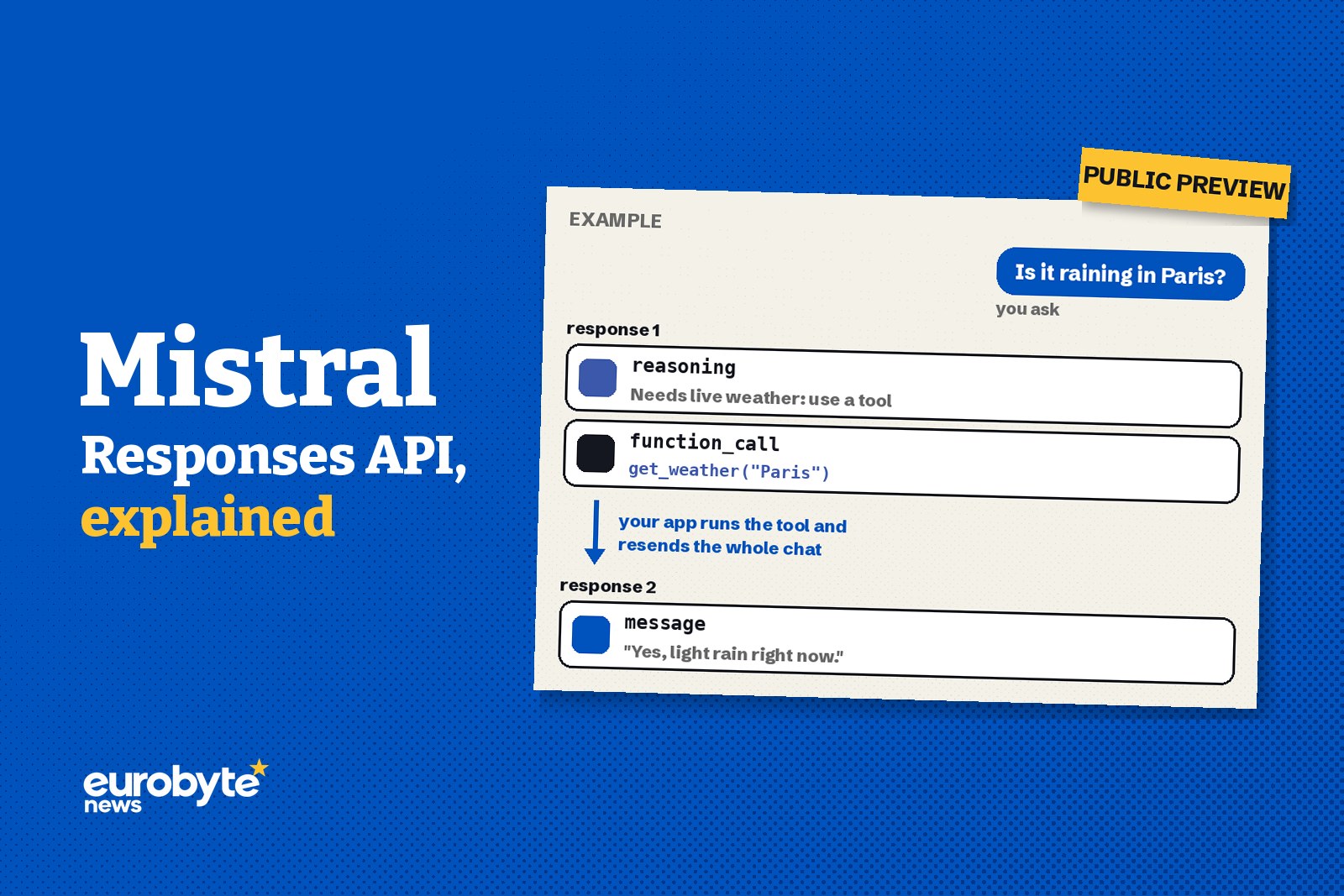
Illustration on a blue background: the words “Mistral Responses API, explained”, with “explained” in gold. On the right, a paper card labelled “Example”: a user asks “Is it raining in Paris?”. Response 1 contains a reasoning item (“Needs live weather: use a tool”) and a function call, get_weather("Paris"). An arrow reads “your app runs the tool and resends the whole chat”. Response 2 contains the message “Yes, light rain right now.” A gold tag reads “Public preview”. Eurobyte News logo bottom left.
An illustrative example: the app runs the requested tool and sends the whole conversation back before the model answers. Illustration; not Mistral's interface. Illustration: Eurobyte / Eurobyte News · Original artwork

On 28 October, Mistral AI posted a short thread on X: it is “introducing the Responses API in public preview, made for building agents on Mistral”. If you read that and thought “I have no idea what that means”, this explainer is for you.

First, what is an API?

An API is the way one piece of software talks to another. When an app uses an AI model behind the scenes, it sends a request through the model maker’s API and gets an answer back. You never see it, but every AI feature in an app runs through one. Mistral’s announcement is aimed at the developers who build those apps, not at people chatting with Le Chat.

And what is an “agent”?

A chatbot answers. An agent can also take steps: look something up, run a calculation, call another service, then answer. To do that, the model has to be able to say “I need a tool for this” and wait for the result.

So what does the Responses API do?

It is a new way for apps to talk to Mistral’s models. Every response is split into separate items: the model’s answer, its reasoning and any tool calls. Mistral says that lets an app handle each step more easily than with its Chat Completions interface, the existing style, where the reply comes back as a single message. The documentation says the tool calls are run by the developer’s own code, not by Mistral.

Why does it copy OpenAI?

OpenAI introduced its own Responses API in March 2025, as a replacement for its Assistants API. Mistral’s documentation says its version lets developers “build with Mistral models using the OpenAI Responses format”.

Think of it as a common plug. If an app was built for OpenAI’s format, moving it to Mistral takes less rework. Crypto Briefing calls this the most immediate effect: lower switching costs, and the option to send some tasks to one provider and some to another.

What is the catch?

Mistral’s version is stateless. Picture a help desk that keeps no notes: every time you call, you tell the whole story again. With Mistral, your app keeps the conversation and sends all of it with each request.

That is the main practical difference from OpenAI’s version, which can manage conversation state for you, by chaining requests to an earlier response or through its Conversations API. OpenAI saves response objects for 30 days by default. With Mistral, developers porting agent code have to store and resend that history themselves. Crypto Briefing notes that this gives teams control but also means more engineering work, and that the API is still a preview.

Why does it matter for Europe?

Mistral says the API works with all the chat models it hosts, including its flagship Large 4, and that it is served in the EU and the US on Mistral AI Cloud Inference. For a European company or public body, that means agent software written for OpenAI’s format can now run on models served from the EU.

Anything else?

In the same thread, Mistral added two fast, low-cost models from other developers: DeepSeek V4.1 Flash, in public preview, and GLM 5.3 Flash, now generally available. DeepSeek, the Hangzhou lab, released V4.1-Flash as an open model in September, and Z.ai published GLM-5.3-Flash with open weights in August.

In one sentence

Mistral now speaks the same “language” for building agents as OpenAI, so apps can switch more easily, but with Mistral the app has to remember the conversation itself.

Sources and credits

Mistral's claims about the API come from its own X thread and documentation; the documentation does not list supported models, pricing or regions, so the EU and US serving and the model coverage rest on the thread. OpenAI's state handling is described from its own documentation. Crypto Briefing is the only independent coverage we found at the time of writing. Z.ai's base is not stated in the sources used, so it is not given here.

  1. Today, we're introducing the Responses API in public preview, made for building agents on Mistral

    Mistral AI · Mistral AI on X ·
    Company announcement

  2. Served in the EU and US on Mistral AI Cloud Inference

    Mistral AI · Mistral AI on X ·
    Company announcement

  3. We're also now serving two fast, low-cost models

    Mistral AI · Mistral AI on X ·
    Company announcement

  4. Responses API

    Mistral AI · Mistral Docs
    Primary document

  5. Conversation state

    OpenAI · OpenAI API documentation
    Primary document

  6. Mistral opens Responses API in public preview, borrowing OpenAI's format for agent builders

    Diego Almada Lopez · Crypto Briefing ·
    Original reporting

  7. OpenAI launches new tools to help businesses build AI agents

    Maxwell Zeff · TechCrunch ·
    Original reporting

  8. DeepSeek launches V4.1-Flash and retires V4-Pro, its flagship model

    Ana Maria Constantin · TNW ·
    Original reporting

  9. Z.ai releases GLM-5.3-Flash

    Jorick van Weelie · DataNorth ·
    Analysis

Editorial process. Written with AI assistance from the sources listed above. Reviewed and approved by Eurobyte Editor, who takes editorial responsibility for this article. Eurobyte conducted no interviews or on-site reporting for this article. The credited sources did not write or endorse it.

Drafting record

Drafting tool: claude-opus-5-5. Recorded checks: Vera pass: every claim checked against the stored source extracts; quotations match word for word; Brief minimum met (primary: Mistral documentation and X thread; independent: Crypto Briefing); no right-of-reply request needed. Read our policy on tools and editorial responsibility.

Follow Eurobyte in Google: add Eurobyte as a preferred source, so our analysis shows up more often in your search results.

Back to the homepage