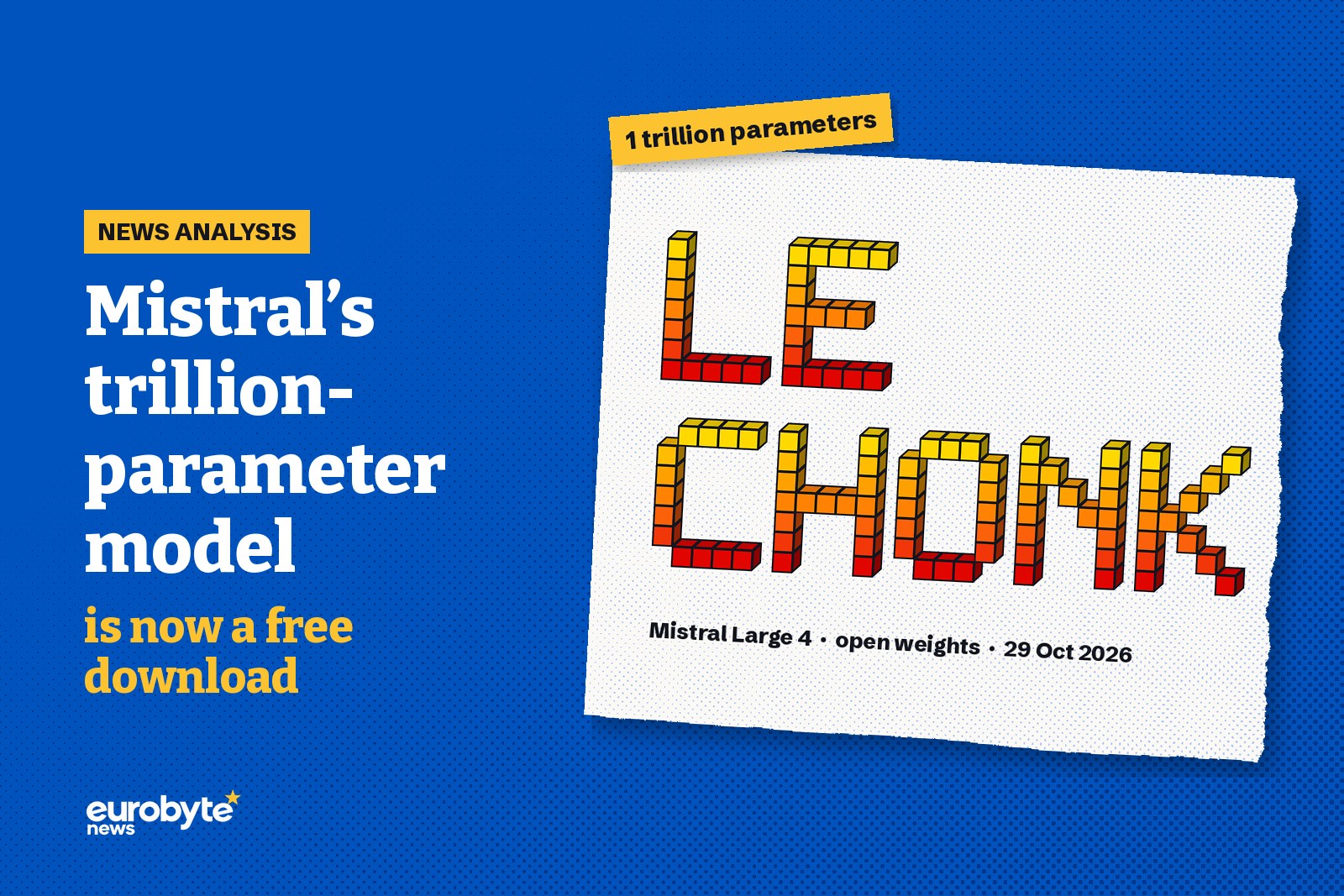
On 29 October, the Paris-based company Mistral AI published the weights of Mistral Large 4, its largest AI model, on Hugging Face, the site where developers share models. The weights are the numbers that make up a trained model. With them, anyone can download the model, run it on their own computers and adapt it, instead of renting it through Mistral’s service.
Mistral first showed the model, which it nicknames “Le Chonk”, as a paid preview in early October. The version now released has had three more weeks of training, TNW’s Ana-Maria Stanciuc reports. On one independent test, it is now narrowly the best open model developed outside China. On that index, no open-weight model from a European company scores higher. Whether it is the right choice depends on the licence, the hardware and what the model is used for.
What Mistral released
Mistral Large 4 has about one trillion parameters, the adjustable values a model learns in training. It does not use all of them at once. According to the model card, it is a mixture of experts: 128 specialised sub-networks, of which four, plus one shared network, handle each token, a word or part of a word. That means about 52 billion parameters are active at a time, or 49 billion if the input and output layers are left out.
The model reads text and images and writes text. It can take in up to one million tokens in one go. The model card says it was trained from scratch on 3,800 Nvidia Grace Blackwell GPUs in its own European data centres. Through Mistral’s own service it now costs $0.70 per million input tokens and $2.10 per million output tokens, against $1.36 and $4.18 during the preview.
How good is it? Mistral’s numbers and an outside check
Mistral calls it the best open-weight model for coding. On Terminal-Bench 4.0, a test of coding tasks in a command line, it reports 41%, up from 28% for the preview. According to TNW, the Chinese model GLM-5.3 scored 40% on the same chart. On a broader coding index, Mistral says Large 4 is effectively tied with GLM-5.3 while using 47% fewer tokens per task. These are Mistral’s own results.
Artificial Analysis, an independent benchmarking firm, gives a more modest picture. On its general Intelligence Index it scores the released model 26, one point above the preview, which makes it the top open model built outside China, but only narrowly. Chinese open models still score higher: according to VentureBeat, DeepSeek and Xiaomi’s MiMo reach higher scores at lower measured cost per task.
The clearer gain is efficiency. Artificial Analysis found the model now produces 39% fewer output tokens per task. Together with Mistral’s lower prices, that cut the cost of one index task by 63%, from $5.54 to $2.06. If you saw a score of 38 earlier this month, that came from an older version of the index and cannot be compared with 26.
Open, with one condition
The weights come with Mistral’s new Ecosystem Open-Weight License, a modified MIT licence. It allows use, changes, retraining and commercial use. The exception is a “Model as a Service” business: anyone who offers the model to third parties for running or further training, in a way that lets those customers control its inputs or settings, needs a separate commercial licence from Mistral first.
Internal use is exempt, and so are products where the model sits inside a specific feature. This suggests that a bank or a ministry can run Large 4 on its own servers freely, while a European cloud company that wants to rent out the raw model to customers would first need a deal with Mistral. That is open weights, not open source in the full sense.
“Runs on a Mac” needs a closer look
The claim that it runs on a Mac Studio rests on a heavily compressed version, and not one made by Mistral. The examples on Mistral’s model card use servers with eight GPUs. Mistral’s own compressed version runs on four Nvidia B200 or B300 GPUs, according to TNW.
The Mac claim comes from Unsloth, a company that makes smaller versions of open models. Its smallest, “1-bit” version takes about 233 GB and, in Unsloth’s words, “should fit on 256GB RAM including a Mac Studio”. Unsloth does not report a tested run on that machine. Unsloth says this version agrees with the full model’s first choice of next word about 91% of the time; a 2-bit version of 378 GB reaches about 95%. That is not the same as keeping 91% of the model’s ability on real tasks, and Unsloth gives no speed figures either.
So an organisation with data-centre GPUs can run it in-house, and someone with a high-end desktop can try a reduced version, without knowing how fast it will be. None of these builds is aimed at laptops. According to TNW, smaller versions, including one for laptops, will follow in the coming months, without dates.
The cyber pitch, and its other side
Mistral aims the model at cyber defence: finding and fixing security flaws. Artificial Analysis puts it third among open models on its Cyber Index, with a score of 51. Mistral lists testing partners including CrowdStrike, Cisco and Orange Cyberdefense, and says ENISA, the EU’s cybersecurity agency, is testing it to find vulnerabilities, audit code and analyse defensive logs.
Pierre Stock, Mistral’s vice president of science, described open weights to TechCrunch’s Lucas Ropek as “Access that can’t be cut off by definition because the model is open-weighted”. He argued that defenders need the capability quickly because attackers may use their own AI tools.
The same openness works both ways, and Mistral says so. After the preview, it observed “a potential for uplift to conduct real attacks”, meaning the model could help attackers. Mistral says it is adjusting its guardrails and gives a more capable, restricted cyber version only to vetted partners such as Orange Cyberdefense. The announcement does not say how the guardrail changes apply to copies that people run themselves.
What it means for Europe
Mistral’s announcement quotes European banks and companies on the model, including ABN AMRO, ASML, Belfius, Crédit Agricole and La Banque Postale, in statements ranging from early experience to broader support for open models. For organisations like these, the main gain is control: they can keep sensitive data on their own systems, though how safe that is depends on how they run it, and they do not need Mistral’s hosted service to keep using the model.
The independence has limits. The model was trained in Europe, but on Nvidia hardware, and running it at full quality still takes data-centre GPUs. Mistral’s chief executive Arthur Mensch told TNW the company has raised about $6 billion in three years, far less than other leading labs. TNW notes that Mistral’s claim to do more with less is hard to test, because Chinese labs disclose little about their training costs.
The next things to watch are independent reruns of Mistral’s coding results and the smaller versions Mistral has promised.